Webmaker/Whitepaper
Mozilla and the webmaker movement
Moving users from consumers to producers of the web
Introduction
“[O]ur world changed in April 1993 when the Mosaic 1.0 browser was released to the general public. We need new forms of education. We need to reform our learning institutions, concepts, and modes of assessment for our age. Now, anyone with access to the World Wide Web can go far beyond the passive consumer model to contribute content on the Web. We can customize and remix, alone or in collaboration with others, located anywhere on the Web. That Do-It-Yourself potential for connected, participatory, improvisational learning requires new skills, what many are calling new “literacies”.” (Davidson, 2012)
At Mozilla, we’re a global community of technologists, thinkers and builders working together to keep the Internet open and accessible. We’re working collaboratively on a global basis to ensure everyone can be informed contributors and creators of the Web. This act of human collaboration across an open platform we believe to be essential to individual growth and our collective future.
Mozilla helps people create, not just consume, the technology, media and information that makes up the Web. Whether it is the thousands of volunteers who write code for Firefox or the growing community that is designing the programs to help people learn how to make the web, the Mozilla community strives for an Internet that is:
- Knowable: it’s transparent–we can see it and understand it
- Interoperable: it presents opportunity to play and innovate
- Ours: it’s open to everyone and we define it
The development of Mozilla products such as the Firefox web browser and Firefox OS for mobile phones rely upon community involvement and contribution. To realize this vision more fully, to ensure the internet is knowable, interoperable and ours, Mozilla recognizes a need to help people around the world learn and teach the web. As part of this the Webmaker project is dedicated to helping people create something amazing on the web, encouraging millions of people around the world to move beyond just using the web towards helping to make it.
Webmaker
What is Webmaker?
The term webmaker is a portmanteau of “web” and “maker” with each of these terms being associated with cultural practices outlined below.
Why do we need Webmaker?
As set out in the Mozilla Manifesto, we believe the web to be an integral part of modern life — a key component in education, communication, collaboration, business, entertainment and society as a whole. Compared with the early days of the web the experience of those new to it is much more focused on consumption than production. While it’s never been easier to put something online or communicate with others, doing so is a process increasingly mediated by commercial, for-profit interests. The openness of the web has also been undermined by practices implicating governments and corporations in practices such as like throttling, filtering and surveillance.
Mozilla’s work is situated within a wider landscape of maker culture with an explicit commitment to the open web. Maker culture is an extension of do-it-yourself (DIY) culture focused on the creative use of technology coupled to a strong ethos around grassroots invention and learning. Central to this is a culture of ‘tinkering’; the Maker Manifesto states: “if you can’t open it, you don’t own it.” Many makers are amateurs — enthusiasts and hobbyists interested in the process as well as the product. An interest in building and supporting the open web is core to many Mozilla projects.
‘Webmaker’ is our term for those participating in the culture of building the social and technical elements required for an open web. Webmakers may complete various activities, including building content for the internet through remix or coding, participating in discussions online, or teaching web literacy skills in their local communities. The profiles below are just a few examples of how some individuals may act as webmakers in different contexts:
What is the pedagogy behind Webmaker?
Mozilla’s work is underpinned by a philosophy that we learn best through doing and making. While our thinking is underpinned by the works of academics in related fields, we’re interested in practical action. We’re focused on encouraging people to become experienced in writing parts of the web and participating in online communities. A recent model known as Connected Learning closely aligns with our approach:
“Connected learning is realized when a young person is able to pursue a personal interest or passion with the support of friends and caring adults, and is in turn able to link this learning and interest to academic achievement, career success or civic engagement. This model is based on evidence that the most resilient, adaptive, and effective learning involves individual interest as well as social support to overcome adversity and provide recognition.” (Ito, et al., 2013)
Learning by making is not a new idea. This concepts is fundamental to the work of foundational thinkers such as Froebel, Dewey, and Papert (amongst many others). For example, Froebel encouraged creative play using wooden blocks as a pedagogical tool; Dewey advocated for experiential learning; and Papert updated ideas around ‘hands-on’ learning for the computer age. Learning theories such as Constructivism and Connectivism influence our work around Webmaker and web literacy — along with, importantly, a sense of play.
Mozilla is well positioned to contribute to the spread and scale of Connected Learning via the Webmaker project. Mozilla brings a non-profit status, a web company, a global brand, an established network of volunteers primed to promote connected learning and web literacy and a dedication to teaching and learning as stated in Mitchell Baker’s 2013 Mozilla Summit address.
Web Literacy
What is Web Literacy?
Mozilla defines web literacy in a broad, inclusive way as the skills and competencies required to read, write and participate effectively on the web. We are interested in teaching the mechanics, culture and citizenship of the web (with ‘web’ currently defined as that which is accessed through a modern web browser).
Why is Web Literacy important?
We believe that everyone should have the skills and competencies to use the web effectively. While not everyone needs to be a fully-fledged programmer, given the ubiquity of the web we should recognise it as a medium to be written and made as well as one to be read and consumed. Many scholars describe these skills as part of digital literacy or digital media literacy. At Mozilla, we use web literacy as a more specific term that emphasizes the web as a key global resource to build and protect.
We help people become citizens of the web because it is a platform that is critical for justice, democracy and equity (Castells, 2013; Jenkins & Thorburn, 2003; MacKinnon, 2012). Our experiences, whether digital or analog, are informed by the web and its cultures. The web is so integrated into our collective daily lives, we believe that web literacy is essential for youth and adults to be positioned for success in our ever-changing world.
The Web Literacy Map
In early 2013 we started the process of creating a Web Literacy Map by bringing together existing Mozilla community members and those interested in the landscape. Over the course of a year we engaged with stakeholders such as educators, volunteers, technologists and academics who helped us identify three strands of ‘Exploring’, ‘Building’, and ‘Connecting’.
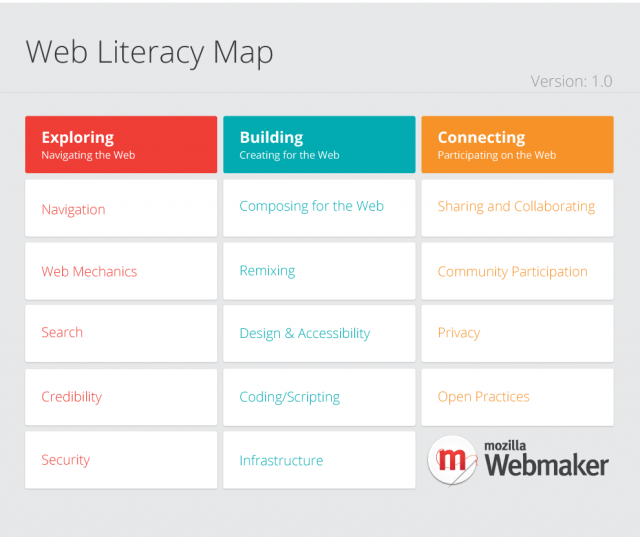
Under each of these strands are collections competencies, which in turn contain a number of skills. The Web Literacy Map constitutes a sense-check for educators — and the raw material on which anyone can build activities to help teach the web.
Webmaker Tools, Community and Resources
The idea to create tools to encourage webmaking stems back to the Mozilla Drumbeat Festival, held in Barcelona in 2010. Since that time Mozilla has continually iterated upon these ideas to create a suite of Webmaker tools to help improve users’ web literacy skills. Webmaker.org currently houses three tools: X-Ray Goggles, Thimble, and Popcorn Maker (with more proposed for the future). Each of these open source tools is used within a web browser and end-users can publish their completed projects to Mozilla servers. Because the tools are open source, community members can contribute to their development and ‘fork’ them for their own purposes if necessary.
X-Ray Goggles
X-Ray Goggles (or Goggles) is a browser plug-in that allows an end-user to see the building blocks of the web. It shows the underlying HyperText Markup Language (HTML) and Cascading Style Sheets (CSS) of the web page being visited. With Goggles, the user can change the code and publish their version of the page. As an example, when Goggles is activated a user can change the headline of the site if it is contained in “heading 1” or an “<h1>” set of HTML tags. Popular X-Ray Goggles projects for new users including remixing the homepage of a newspaper or school.
Thimble
Thimble is an HTML editor and preview pane, which displays in a single browser window. To the end-user, the code appears in the left pane, and the preview of the page of the rendered web page in the right. Thimble excels at allowing users to create a new webpage or alter a one page project. Popular Thimble projects at Webmaker for new users include remixing an internet meme, a magazine cover, or comic strip. Projects from Thimble can be published to Mozilla servers and shared.
Popcorn
Popcorn is a multimedia editor that works out of a browser window. Popcorn was created to be an HTML5 media framework, to demonstrate that the web is interoperable and media elements can be recombined. Within Popcorn, the user sees a timeline where they can add video clips, sound files, images, animated Graphics Interchange Format (GIF) files, Wikipedia pages, Google maps and more. Common first projects in Popcorn include a video to introduce oneself or to tell a story.
In addition to the tools, there are resources to assist those educators and mentors who wish to teach the web. These Open Educational Resources (OERs) include complete teaching kits as well as more granular resources to make it easier to teach web literacy. The customizability and modularity of OERs are their major value (Tseng & Piller, 2003). As one brief example, the StoryCamp kit assists facilitators who want to empower youths to tell their stories online. In the future, this kit could be remixed to empower youth to tell stories about collaboration, privacy or other web competency areas. Mozilla believes that the use of the Webmaker tools and teaching kits help facilitate participatory cultures where there are “relatively low barriers to artistic expression and civic engagement, strong support for creating and sharing creations, and some type of informal mentorship” (Jenkins, et al., 2009, p. xi).
Conclusion
Mozilla is building the tools, the community and the resources to help teach the web. Webmaker tools are low floor, high ceiling on-ramps for those interested in learning and teaching the web in ways that reflect the Mozilla manifesto. The Webmaker community explores the frontiers of web literacy and organizes around the ideas of learning through making. The resources developed by this community are designed to help people gain and improve their skills around reading, writing, and participating on the web.
The Webmaker movement is made up of people like you. People who take our site and kits and teach people the web over the kitchen table. People who use our tools in more informal learning settings like community centers or youth groups. People who use Webmaker as part of a curriculum in schools or beyond. And people who join Mozilla’s community and participate in creating open source projects and teaching resources to teach the web.
Webmaker is your project. Be part of it.
Get involved!
There are many ways to get involved in Mozilla’s Webmaker project, from dipping your toe in the water for the first time through to running large events and helping us with future directions.
- Create an account at Webmaker.org and start making the web
- Attend or host a Maker Party
- Join the Webmaker discussion group
- Participate in one of the weeekly #TeachTheWeb community calls
- Follow @webmaker on Twitter and use the [#teachtheweb](https://twitter.com/search?q=%23teachtheweb&src=typd) hashtag
Bibliography
American Library Association. (2007). Standards for the 21st Century Learner. http://www.ala.org/aasl/sites/ala.org.aasl/files/content/guidelinesandstandards/learningstandards/AASL_Learning_Standards_2007.pdf
Booth, D.R. (2012). Peer Participation and Software: What Mozilla Has to Teach Government. The John D. and Catherine T. MacArthur Foundation Reports on Digital Media and Learning. Cambridge, MA: The MIT Press. http://mitpress.mit.edu/sites/default/files/titles/free_download/9780262514613_Peer_Participation_and_Software.pdf
boyd, d. & Hargittai, E. (2010). Facebook Privacy Settings: Who Cares? First Monday 15(8). http://firstmonday.org/htbin/cgiwrap/bin/ojs/index.php/fm/article/view/3086/2589.
Buckingham, D. (2003). Media Education: Literacy, Learning & Contemporary Culture. Cambridge: Polity Press.
Coiro, J., Knobel, M., Lankshear, C. & Leu, D. J. eds. (2008). Handbook of research on new literacies. Philadelphia: Erlbaum.
Castells, Manuel. (2012). Networks of outrage and hope: Social movements in the Internet age. Cambridge: Polity Press.
Connected Learning Principles. (no date).Connected Learning. http://connectedlearning.tv/connected-learning-principles
Davidson, C.N. & Goldberg, D.T. (2010). The Future of Thinking: Learning Institutions in a Digital Age. The John D. and Catherine T. MacArthur Foundation Reports on Digital Media and Learning. Cambridge, MA: The MIT Press. http://mitpress.mit.edu/sites/default/files/titles/free_download/9780262513746_Future_of_Thinking.pdf
Davidson, C.N. (2012). Why We Need a 4th R: Reading, wRiting, aRithmetic, algoRithms. DMLcentral. http://dmlcentral.net/blog/cathy-davidson/why-we-need-4th-r-reading-writing-arithmetic-algorithms
Davidson, C.N. (2011). Now You See It : how the brain science of attention will transform the way we live, work, and learn. New York: Viking.
Gee, J. P. (2009). Digital Media and Learning as an Emerging Field, Part I: How We Got Here. International Journal of Learning and Media, 1(2), 13–23.
Ito, M., et al. (2009). Living and Learning with New Media: Summary of Findings from the Digital Youth Project. The John D. and Catherine T. MacArthur Foundation Reports on Digital Media and Learning. Cambridge, MA: The MIT Press. http://mitpress.mit.edu/sites/default/files/titles/free_download/9780262513654_Living_and_Learning.pdf
Ito, M., et al. (2013). Connected Learning: An Agenda for Research and Design. Digital Media and Learning Research Hub. http://dmlhub.net/publications/connected-learning-agenda-research-and-design
Jenkins, H. & Thorburn, D. (eds). (2003). Democracy and new media. Cambridge, Mass.: MIT Press.
Jenkins, H., et al. (2009). Confronting the Challenges of Participatory Culture: Media Education for the 21st Century. The John D. and Catherine T. MacArthur Foundation Reports on Digital Media and Learning. Cambridge, MA: The MIT Press. http://mitpress.mit.edu/sites/default/files/titles/free_download/9780262513623_Confronting_the_Challenges.pdf
Lessig, L. (1999). Code and Other Laws of Cyberspace. New York: Basic Books.
MacKinnon, Rebecca. (2012). Consent of the networked: The world-wide struggle for Internet freedom. New York: Basic Books.
New London Group. (1996). A pedagogy of multiliteracies: Designing social futures. Harvard Education Review 66(1), 60–92.
Papert, S. (1980). Mindstorms: Children, Computers, and Powerful Ideas. New York: Basic Books.
Porter, M.E. (1980). Competitive Strategy. New York, Simon and Schuster.
Rheingold, H. (2012). Net Smart: How to Thrive Online. Cambridge, MA: MIT Press.
Rushkoff, D. (2011). Program or Be Programmed: Ten Commands for a Digital Age. New York: O/R Books.
Salen, K., et al. (2010). Quest to Learn: Developing the School for Digital Kids. The John D. and Catherine T. MacArthur Foundation Reports on Digital Media and Learning. Cambridge, MA: The MIT Press. http://mitpress.mit.edu/sites/default/files/titles/free_download/9780262515658_Quest_to_Learn.pdf
Santo, R. (2012). Hacker Literacies: Synthesizing Critical and Participatory Media Literacy Frameworks. International Journal of Learning and Media. 3(3), pp.1-5.
Tseng, M., & Piller, F. (2003). The customer centric enterprise: advances in mass customization and personalization. New York: Springer
Udell, J. (2011) ‘Seven Ways to Think Like the Web’, Weblog, http://blog.jonudell.net/2011/01/24/seven-ways-to-think-like-the-web/
Wing, J.M. (2008). Computational Thinking and Thinking about Thinking. Philosophical Transactions of The Royal Society. 366. pp.3717-3725.