|
|
| (46 intermediate revisions by 7 users not shown) |
| Line 1: |
Line 1: |
| __NOTOC__ | | __NOTOC__ |
| | [[Image:P2pu school of webcraft -- logo.png|300px]] |
|
| |
|
| = Open web developer training for the world. Powered by everyone. =
| | *'''P2PU School of Webcraft: Developer training that’s free, open and globally accessible''' |
| | *The goal: skills and certification that build careers on open web technology |
| | *The problem: developer training that's expensive, out of touch, and out of reach |
| | *The solution: peer learning powered by mentors and learners like you |
| | *Self-organized study groups. Using existing open learning materials |
| | *You can get involved. Take a class; propose a course; make a contribution |
|
| |
|
| <br> [[Image:P2pu school of webcraft -- logo.png|left|300px]] | | = Web developer training that's free, open and globally accessible = |
| | Mozilla and Peer 2 Peer University are creating the P2PU School of Webcraft, a new way to teach and learn web developer skills. Our classes are globally accessible, 100% free, and powered by learners, mentors and contributors like you. |
| | <br> |
|
| |
|
| '''Mozilla and Peer 2 Peer University are creating the P2PU School of Webcraft, a great way to learn standards-based web development.''' Our goal: enabling people around the world to easily access and build careers on open web technology.
| | = The goal - enable developers to build careers on open web technology<br> = |
|
| |
|
| <br>We're using Peer 2 Peer University's platform for "learning for everyone, by everyone" that is powered by learners, mentors, and contributors like you. P2PU School of Webcraft will offer online courses focused on practical, project-based developer training. Courses are proposed, developed and led by active web developers, which means they are always up to date and focused on real-world projects. And everything is globally accessible and 100% free and open.
| | Our goal is to provide training and certification that allows more people to build careers on open web technology. We believe technical training and certification no longer needs to be expensive, exclusive or proprietary. By training a new generation of developers in open source values and skills, we can spread opportunity while supporting open standards and values that improve the open web itself.<br> |
|
| |
|
| = Building careers on open web technologies = | | = The problem - training & certification that are expensive, out of touch, and out of reach<br> = |
|
| |
|
| '''P2PU Webcraft will provide skills anyone can use to build web development careers'''. From static HTML sites to reading code to advanced social web applications, learners will develop strong "hacker habits," practical experience, and the skills to build a better web through a commitment to open standards and tools. We will also offer accreditation, badges and certificates that industry leaders will recognize and respect. And because courses centre on hands-on building through a project-based approach, learners can build a portfolio of work and gain the practical open source experience employers want.<br>
| | Traditional developer training is expensive, and can be out of touch with current practise and disconnected from what students and employers really need. Many certificate courses focus on a single proprietary technology, limiting students' exposure to the broad mix of tools today's developers need. Four-year programs are out of reach for many, or based on rigid curricula that are not designed to keep pace with new developments in the field. And a lack of practical experience fails to provide students with portfolios or give employers a sense of their actual skills as a developer.<br> |
|
| |
|
| '''<strike>We believe technical training and certification no longer needs to be expensive, exclusive or proprietary'''. P2PU Webcraft invites the world to learn, share and participate in developing strong technology careers, self-empowerment, and a better web.<br></strike>
| | = The solution = |
|
| |
|
| = The problem: developer certification that's expensive, out of touch, and out of reach<br> = | | === Peer learning powered by mentors and learners like you<br> === |
|
| |
|
| '''Traditional developer training and certification is cumbersome, often different from what students and employers really need, and priced out of reach for too many. '''Certificate courses <strike>like Cisco Academy or MCSE, </strike> tend to focus on a single proprietary technology -- limiting student's exposure to a the broad mix of tools and platforms that are needed in the current web development climate. <strike>effectively locking in students to increase their market share, and ignoring the fact that today's developers must draw on a broad mix of tools and platforms to learn, hack and be creative. </strike> Access to this proprietary technology and software is also expensive, adding economic barriers to entry. <br>
| | P2PU School of Webcraft enables anyone to learn the latest technical skills and gain the practical experience that employers are looking for. Courses focus on real-world projects and are organized by peers who are web developers themselves. This enables participants to build portfolios of work, gain the practical open source experience employers want, and collect badges and certification industry will recognize.<br> |
|
| |
|
| <strike> Four-year university degrees are out of reach for many and don't respond to the needs of web developers, with curriculum that can be out of date or overly theoretical. And many unscrupulous private certification providers take advantage of learners' lack of experience with expensive courses that are of dubious quality and little practical benefit.<br> </strike>
| | Anyone can propose new course ideas and learning materials any time -- allowing P2PU to move faster and stay more up to date on current technologies than traditional programs. That way courses can offer practical training in areas like HTML5 and social web technologies mainstream schools are not yet covering, with an emphasis on pragmatic skills like reading code that traditional programs lack.<br> |
|
| |
|
| '''Many traditional accreditation programs ignore the fact that the best developers teach themselves'''. Even amongst developers with degrees, the most valuable learning is generally self-taught or comes from engagement with peers. This hacker attitude and ability to work with peers is crucial, since it's how the best developers learn and practise their craft in the real world. <br>
| | === Self-organized study groups using existing open learning materials<br> === |
|
| |
|
| = The solution: learning with your peers - ''and'' meaningful assessment of your skills.<br> =
| | Excellent open educational materials already exist. P2PU School of Webcraft adds peer learning and assessment. Courses are facilitated by practitioners who guide and support participants' independent learning. Working in small self-organized study groups, peer learners not only gain technical skills, but also an attitude and approach to web development -- "hacker habits" -- that reflects the way great developers think, solve problems and collaborate. <br> |
|
| |
|
| '''P2PU School of Webcraft delivers peer learning on demand, with training that's responsive to the innovation of the open web'''. We're designing a curriculum of courses -- proposed by anyone, any time, anywhere -- that give learners a pathway from novice web developer to advanced web craftsman. The focus is on project portfolios, hacker attitudes and developer challenges -- rather than hours spent in front of a book followed by an exam that has little relevance to the real world. And developing a new way of assessing and recognising skills and knowledge, through transparent certification and badges.<br>
| | = You can get involved. Take a class; propose a course; make a contribution.<br> = |
|
| |
|
| '''P2PU Webcraft takes the "do it yourself" ethos the best developers have already and turns it into a scalable way to teach and learn'''. Peer learners are not only gaining technical skills, but also a certain attitude and approach to web development that we call "hacker's habits". Through an online learning environment that simulates actual working conditions and allows participants to develop communication, collaboration and leadership skills. Learning at the P2PU School of Webcraft behaves more like the open web itself: distributed, global, self-organizing and constantly evolving. Providing the missing link in the between auto-didacts and institutions. <br>
| | Have a course you want to teach? Interested in honing a particular web development skill? Got learning materials or ideas to contribute? Get involved at http://drumbeat.org/p2pu-webcraft<br> |
|
| |
|
| <strike>'''Where there's a new technology or skill to be learned, we don't have to wait for someone's permission'''. Courses can be organised and run as required. People can begin to learn without having to wait for courses to be approved by a committee. Peer learners are not only gaining technical skills, but also a certain attitude and approach to web development that we call "hacker's habits". Through an online learning environment that simulates actual working conditions and allows participants to develop communication, collaboration and leadership skills. <br> </strike>Moved the hacker's habit part up, and cut out the other point. --[[User:Philipp|Philipp]] 14:17, 30 June 2010 (UTC)
| |
|
| |
|
| = Democratizing web developer education.<br> = | | = Courses already proposed for September= |
|
| |
|
| '''Our long term vision is to build web development courses that progress beyond the expensive and outdated training options that exist today'''. Establishing the P2PU School of Webcraft as a grassroots league of extraordinary open web developers. Spreading opportunity and open standards that not only build careers on open web technology, but that also help build and improve the open web itself.
| | *Mashing Up the Open Web |
| | *HTML5 |
| | *Web Development 101<br> |
| | *Principles of Project Management |
| | *Building Social with the Open Web<br> |
| | *Reading Code<br> |
| | *Semantic Markup<br> |
| | *Organic SEO Basics |
| | *What is PHP?<br> |
|
| |
|
| By training a new generation of developers in open source values and skills, we can can massively impact the open web's future. And establish web development as a creative endeavour independent of a particular set of proprietary technological tools or platforms.<br>
| | <br> |
|
| |
|
| = Project info-graphic = | | == Project info-graphic == |
| ''First-draft info-graphic. This is a doodle only -- NOT actual design.''
| |
| [[File:P2PU_infographic_--_draft_1.001.jpg|600px]]
| |
|
| |
|
| <br>
| | ''Doodle only -- NOT actual design. Designer is working on first design pass now.'' [[Image:P2PU infographic -- draft 1.001.jpg|600px]] |
|
| |
|
| <br> | | <br> |
|
| |
|
| <br> | | <br> |
| | |
| | <br> |
|
| |
|
| == Notes & Feedback == | | == Notes & Feedback == |
|
| |
|
| *Should be 25% shorter.
| | Moved all comments to the [https://wiki.mozilla.org/Talk:Drumbeat/p2pu/one_pager Discussion] page. --[[User:Philipp|Philipp]] 10:17, 2 July 2010 (UTC) |
| *<strike>Doesn't mention Mozilla anywhere! How do we want to mention this relationshipn and co-branding opportunity? Mozilla can offer huge credibility and immediate trust. How do we leverage that?</strike> (Added to first sentence.)<br>
| | |
| *This feels like the right tone mostly, but kind of weak tea in places. Or pulling taffy, where we repeat the same vauge aspirational platitudes. What's needed for the next draft is tightening up sections where we repeat the same vauge truisms, and instead inject more real detail, insider examples, etc. <br>
| | ==PDF== |
| *Need more specifics on how to get involved. When courses start, the program structure, etc. Not overly granular process stuff, but right now you could read the whole thing and have little understanding of how to get involved or the practical nuts and bolts of actuall classes. <br>
| | [[File:P2PU_Webcraft_one-pager_--_8.5_x_11_inches_--_July_2010.pdf]] |
| *Would be good to test this draft with real developers! Their bullshit detectors will be more finely honed. <br>
| |
| *We haven't mentioned anything above about particular target geographies, like high growth technology sectors with a strong bent towards certification like India, East Asia and Brazil. We want peer learning and accreditation to emerge as open web career path alternatives in these regions.
| |
| *Not enough mention of the benefit of open source? once you begin as a web developer, your skills are easy and affordable for you to implement and legally start developing right away on systems you have immediate access to and can help shape and guide. Becoming not just a web developer, but someone who can influence how web development happens in future.<br>
| |
| *Suggested alt text (1st para): ''Our classes are globally accessible, 100% free, and powered entirely by learners, mentors, and contributors like you. Our goal: a vibrant, peer-led system that helps people around the world easily access and build careers on open web technology.''
| |
| *I would just delete this sentence (2nd para): ''Instead of the dated or overly theoretical courses offered through traditional programs.''
| |
| *In general, I favor a tone that is more about empowerment and opportunity rather than a put-down of existing (and especially commercial) offerings. It can be a tricky negotiation because obvious part of the motivation is indeed the lack of inexpensive, quality pathways to web developer competence. But the point can be made obliquely. For example, ''At P2PU School of Webcraft, the courses are grounded in real-world projects, utilize the latest technical tools and skills, and are totally organized by a vibrant community of '''your''' peers. Don't settle for the same old thing when you can join in the cutting edge of learning, networking, and portfolio-building.'' Or something like that.
| |
| *I agree with the comment that there should be the occasional mention of concrete steps that can be taken. E.g., ''Have a course you want to teach? [http://wiki.mozilla.org/Drumbeat/p2pu/courses Please do].'' Or ''Hoping to improve your web hacker skills? [http://p2pu.org/course/list Check out our current catalog].''
| |
| *Another thing to emphasize is that P2PU can move much more quickly on current technologies than a traditional university. Things like HTML5 and the Social Web technologies won't be touched for a long time in mainstream schools. Also, an emphasis on pragmatic skills... I haven't seen a 'reading code' class in a traditional university, which is really absurd when you think about it :) These are some of our core value propositions.<br>
| |
|
| |
|
| '''Feedback from core P2PU (not School of Webcraft community):'''
| | [[Category:p2pu]] |
| * I agree with most of the comments on the bottom of the page. Cut the bullshit--the iterative fluff around aspirations, etc. It reads like an ad for a profit venture. I think bringing over some text from the p2pu PR's and site would be good here... https://docs.google.com/Doc?docid=0AVCvhUfKWuB3ZGRnNnRwOTZfMWN0cTJia2Ri&hl=en_GB
| |
| * One other point (besides all the valid stuff already in the comments), there is this repetition of "hacker" in reference to "mindset" and "attitude"... as a nondeveloper I just don't know what that means. I don't even know if I want to know what it means--it sounds like a community that is closed and/or foreign to me, and not exactly appealing. Maybe a brief history two sentence history on the term and a link to Wikipedia.
| |
| * Otherwise, the actual website for school of webcraft is looking good...
| |
| * I agree to all the comments posted on the wiki. I especially don't like us trying to become the ivy league of web developers or whatever, to me ivy league doesn't give good connotations at all, rather musty, exclusionary, brand rather than content based, etc.
| |
| * * one thing that jarred a little is that we call this P2PU School of Webcraft in the first opening paragraph, but then refer to it as P2PU Webcraft from that point on.
| |
| * the reference to 'hacker habits' is very vague and for a lot a people will mislead them. 'Hackers' in this context are self taught programmers rather than the other image that term evokes which is the geek sitting in a dark room hacking into your bank account. I still think Paul Graham' essay 'Hackers and Painters' (http://www.paulgraham.com/hp.html) is still one of the most useful pieces in understanding this, and his piece on " The Word Hacker" : http://www.paulgraham.com/gba.html . As Jane suggested it might useful to point people to something to get a little context?
| |
| * I agree with above ... the use of the phrase 'ivy league' made me whince a little since it evokes an image of exclusivity and elitism that are think are counter to what we are actually about.
| |
| * The point about about four year degrees was absolutely correct. Its important to bear in mind that there's a difference between the four year degrees that are theoretical like : Computer Science, and the more vocational degrees that are offered by many universities such as the New Media and Web Development. But I agree with the main point which is that these are out of reach, and often redundant by the time you finish your degree. If our industry changes every six months, how relevant is what you have learnt over that four years?
| |
| * "All of these traditional accreditation programs ignore the fact that the best developers teach themselves" - is anyone ever truly self-taught? The best developers or 'hackers' are self motivated and take a pro-active interest in acquiring knowledge, but that knowledge comes from seeking out the resources and peers from whom they can learn. We are all standing on the shoulders of others.
| |
| * Is it me or is the tone of this slightly antagonistic? 'doesn't suck', 'meaningless' etc.
| |
| * Overall I think its just too wordy, and sounds too 'commercial'. It doesn't resonate in the same way some of the pieces we have written for P2PU do? there's a distinct lack of P2PU'ness ( jeez I really got out of bed wrong this morning )I wonder if it could be made more succinct, with more of an emphasis on empowerment? and in the P2PU 'voice' .
| |
| * Oh and finally to parapharase Jerry McGuire ..... "you had me at 'advanced technical ninja' " ;-)
| |

- P2PU School of Webcraft: Developer training that’s free, open and globally accessible
- The goal: skills and certification that build careers on open web technology
- The problem: developer training that's expensive, out of touch, and out of reach
- The solution: peer learning powered by mentors and learners like you
- Self-organized study groups. Using existing open learning materials
- You can get involved. Take a class; propose a course; make a contribution
Web developer training that's free, open and globally accessible
Mozilla and Peer 2 Peer University are creating the P2PU School of Webcraft, a new way to teach and learn web developer skills. Our classes are globally accessible, 100% free, and powered by learners, mentors and contributors like you.
The goal - enable developers to build careers on open web technology
Our goal is to provide training and certification that allows more people to build careers on open web technology. We believe technical training and certification no longer needs to be expensive, exclusive or proprietary. By training a new generation of developers in open source values and skills, we can spread opportunity while supporting open standards and values that improve the open web itself.
The problem - training & certification that are expensive, out of touch, and out of reach
Traditional developer training is expensive, and can be out of touch with current practise and disconnected from what students and employers really need. Many certificate courses focus on a single proprietary technology, limiting students' exposure to the broad mix of tools today's developers need. Four-year programs are out of reach for many, or based on rigid curricula that are not designed to keep pace with new developments in the field. And a lack of practical experience fails to provide students with portfolios or give employers a sense of their actual skills as a developer.
The solution
Peer learning powered by mentors and learners like you
P2PU School of Webcraft enables anyone to learn the latest technical skills and gain the practical experience that employers are looking for. Courses focus on real-world projects and are organized by peers who are web developers themselves. This enables participants to build portfolios of work, gain the practical open source experience employers want, and collect badges and certification industry will recognize.
Anyone can propose new course ideas and learning materials any time -- allowing P2PU to move faster and stay more up to date on current technologies than traditional programs. That way courses can offer practical training in areas like HTML5 and social web technologies mainstream schools are not yet covering, with an emphasis on pragmatic skills like reading code that traditional programs lack.
Self-organized study groups using existing open learning materials
Excellent open educational materials already exist. P2PU School of Webcraft adds peer learning and assessment. Courses are facilitated by practitioners who guide and support participants' independent learning. Working in small self-organized study groups, peer learners not only gain technical skills, but also an attitude and approach to web development -- "hacker habits" -- that reflects the way great developers think, solve problems and collaborate.
You can get involved. Take a class; propose a course; make a contribution.
Have a course you want to teach? Interested in honing a particular web development skill? Got learning materials or ideas to contribute? Get involved at http://drumbeat.org/p2pu-webcraft
Courses already proposed for September
- Mashing Up the Open Web
- HTML5
- Web Development 101
- Principles of Project Management
- Building Social with the Open Web
- Reading Code
- Semantic Markup
- Organic SEO Basics
- What is PHP?
Project info-graphic
Doodle only -- NOT actual design. Designer is working on first design pass now. 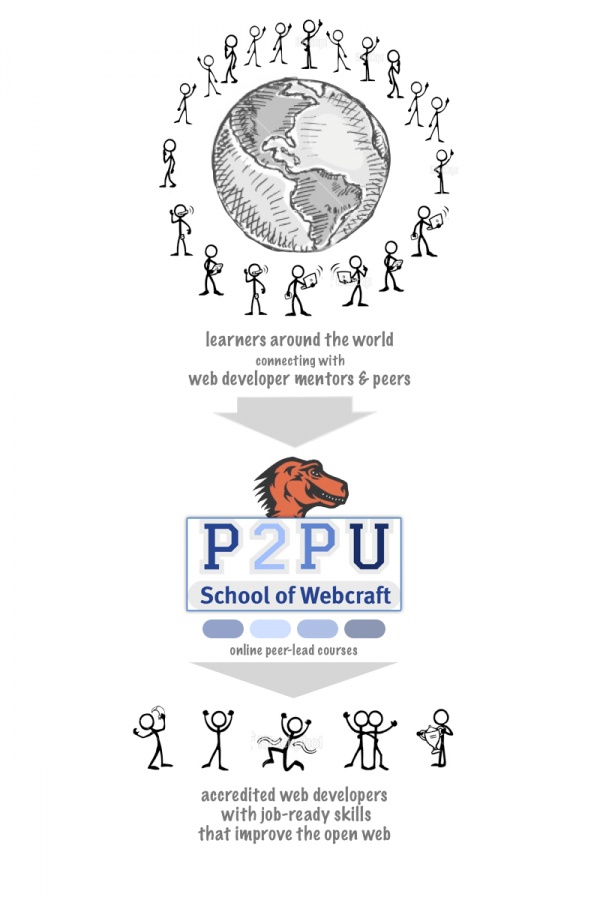
Notes & Feedback
Moved all comments to the Discussion page. --Philipp 10:17, 2 July 2010 (UTC)
PDF
File:P2PU Webcraft one-pager -- 8.5 x 11 inches -- July 2010.pdf

